

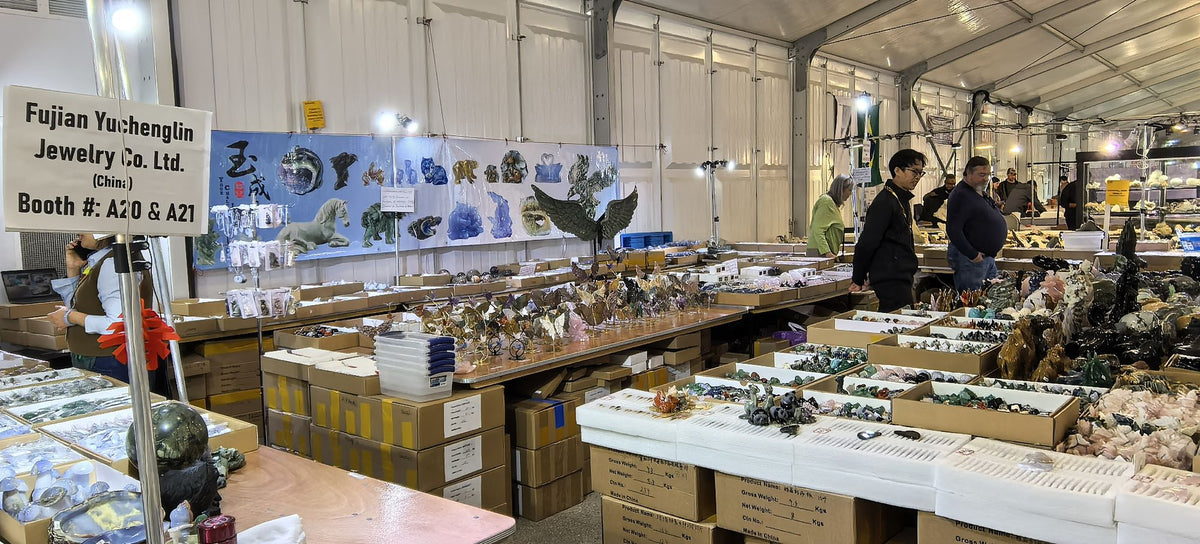
To buy crystal carvings wholesale, decide what you will stock and what you can spend, choose where to buy, request catalogs, and send every supplier the same written inquiry. Before anything ships, confirm minimums, sizes and photos of the finished pieces. When the cartons arrive, check each piece against the packing list. The steps below follow that order. For how ordering works with us specifically, see our wholesale program.
Step 1: Decide what you will stock and set an opening budget
Start from your shelves, not from a supplier's catalog. Write down the categories you want (for example skulls, animals or polished shapes), the sizes that fit your fixtures, and the stones your customers already ask for by name. Then turn that into a piece count, because minimums in carving catalogs like ours are set per item, not per order.
Here is a worked example using the typical minimums in our current wholesale catalog: 10 pieces per design for carvings up to about 3–4 in, 5 pieces around 4.5–5 in, and 2 pieces at 6–8 in. An opening assortment of six small designs and two 6-inch display pieces comes to 6 × 10 + 2 × 2 = 64 pieces. Price that list once you have a quotation, and keep a reserve for freight and any import costs, which may not be included in the unit price (see step 7).
Step 2: Have your business details ready
Expect a wholesale supplier to ask who you are before quoting: your registered business name, shipping address, country and a contact email. If you buy from US wholesalers, ask your state's revenue department how resale certificates work where you are, since some suppliers ask for one.
If you buy from a factory abroad, decide who will be the importer of record. U.S. Customs and Border Protection puts it plainly: "you, the importer of record, are ultimately responsible for the correctness of the entry documentation presented to CBP" (CBP tips for new importers). A licensed customs broker can prepare the entry, but CBP notes that importers who use a broker remain responsible for it.
Step 3: Choose where to buy
| Channel | Works well for | Trade-off |
|---|---|---|
| Gem and mineral shows | Handling pieces before you buy and meeting suppliers in person | Travel, fixed show dates, and carrying or shipping stock home |
| Wholesale marketplaces | Small opening orders from many brands on one platform | You buy what is listed; custom sizes or stones need a direct conversation with the maker |
| US wholesalers and distributors | Domestic stock and shipping, with no import paperwork on your side | Selection depends on their inventory, and their margin is in the price |
| Direct from a carving factory | Choosing stone and size per design, larger quantities, custom designs | Per-item minimums, production and freight time, more back-and-forth |
You can also combine channels: test designs through a show or a marketplace, then buy the ones that sell direct from a factory. If you are at the Tucson shows in late January or February, our booths are listed on our trade shows page.

Step 4: Request catalogs and shortlist by model number
A wholesale catalog should let you compare items line by line: a model number, size, weight, price basis and minimum for each one. Our two wholesale catalogs (July 2026, US edition) cover skull carvings, and crystal shapes and polished stones. Prices are quoted in USD per piece, or per kilogram for stones sold by weight.
Shortlist by model number rather than by photo. Two carvings that look alike in pictures can differ in size by an inch or more, and the same design often comes in several stones and sizes, each a separate line. Note the model number, stone, size and quantity for every line. That list becomes your inquiry.
Step 5: Read the minimums correctly
In our catalog, minimums are set per item: one design in one stone at one size. A 3-inch skull in rose quartz and the same skull in black obsidian are two items, each with its own minimum. Small polished shapes are typically 50 pieces per design, and stones sold by weight start at 10 kg. Your quotation confirms the minimum for each item.
Other suppliers count differently. Some set a minimum per design across stones, some a minimum order value. Ask which rule applies before you build your list, or a "low minimum" can turn into a larger order than you planned.
Step 6: Send one written inquiry to every supplier
Send each supplier the same list so the quotes can be compared. Our wholesale page lists what to include. Ask that the quotation state, for each line, the unit price and its basis, the minimum, and the size it refers to; and for the order as a whole, the lead time, payment terms, trade term, packaging, and what happens if a stone runs short. Anything left out of the quotation is open to misunderstanding later.
Step 7: Confirm the trade term and import costs
The trade term in a quotation (an Incoterms rule such as FOB or DDP, plus a named place) decides where the seller's costs and risks end and yours begin. The International Chamber of Commerce describes the rules as trade terms that clarify "the tasks, costs and risks involved in the delivery of goods from sellers to buyers"; Incoterms 2020 is the current edition (ICC).
For imports into the US, ask how the pieces or their containers will be marked with the country of origin. Under 19 CFR 134.11, unless an exception applies, imported articles (or in some cases their containers) must be marked with the English name of the country of origin. Our carvings are made in China. Duty rates and classification are questions for a customs broker or CBP; we do not give tariff advice.
Step 8: Approve the finished pieces before they ship
Natural stone varies in color, pattern and structure, so the pieces you receive will differ a little from catalog photos. For designs where color or banding matters, ask for photos or video of the finished pieces before shipment. With us, photos or video of finished pieces are available for approval on request. Dimensions and weights refer to recorded samples; production dimensions, tolerances, finish, packaging and availability are confirmed with your quotation.

Step 9: Inspect the delivery the day it arrives
-
Photograph the cartons
Before opening, photograph every carton, especially any that are crushed, wet or re-taped.
-
Count against the packing list
Check quantities by model number, stone and size, not just the total piece count.
-
Check every piece
Look for chips and cracks, and pay attention to thin parts such as ears, wings, horns and tails, which are the parts most easily broken.
-
Report in writing
Send photos and a list of problems within the claim window you agreed with the supplier. Ask what that window is before you order, and keep the packaging until any claim is settled.
When you price and tag the pieces, use the stone names on the invoice. If any material is man-made, say so: goldstone is a man-made glass and terahertz is a man-made material, and we label both as man-made; the other materials in our catalog are natural stone, not dyed and not heat-treated.
Step 10: Keep records for reorders
Record the model number, stone and size of every piece that sells, and reorder by model number. For seasonal stock such as Halloween carvings, ask for the current lead time well before you plan the order, because production and freight both take time.