

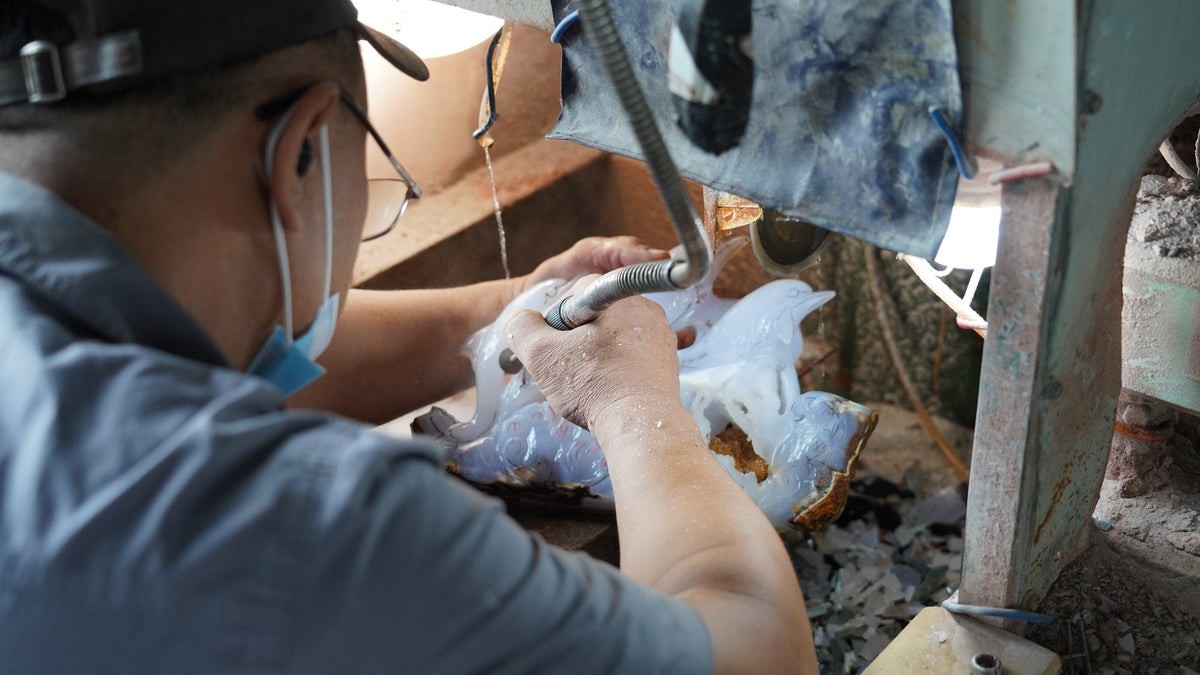
Turkish blue chalcedony is a pale, translucent blue variety of chalcedony, the microcrystalline form of quartz, mined in Anatolia. As of November 2026 it is offered in 54 designs in our blue chalcedony carvings collection, more than any other stone in our catalog. This guide covers where the material comes from, how its color and translucency vary, how it behaves on the carving bench, and the treatments and look-alikes a buyer should know about.
What blue chalcedony is
Chalcedony is silica (SiO2) made of quartz fibers far too small to see. The International Gem Society gives it a hardness of 7 and calls it a tough gemstone that is usually cabbed or carved. Blue chalcedony is a recognized color variety, and the International Gem Society notes that some blue chalcedony shows a slight floating sheen (adularescence) caused by light interference from layers of microscopic inclusions.
Blue chalcedony is found in several countries. Rock & Gem magazine names Turkey, Namibia and Montana as prime locations.
What geologists have found in Turkey
At least one Turkish blue chalcedony deposit has been studied in detail. According to the abstract of a 2013 study in Ore Geology Reviews, blue chalcedony nodules have been mined from that deposit since ancient times. They occur within a sandstone (arkose), are made only of chalcedony and moganite (another fibrous form of silica), and oxygen isotope data suggest they formed at a low temperature of around 55 °C. The study describes that one deposit; it is not a record of where any particular lot of rough was mined.
Our material: source and records
Our blue chalcedony is natural chalcedony from Turkey (Anatolia). It is not dyed and not heat-treated. A 2017 report from AGIL (Asian Gemmological Institute and Laboratory, Hong Kong) identified a sample of this material as natural chalcedony.
Lapidary Journal Jewelry Artist, in its January/February 2020 issue, wrote about our Turkish blue chalcedony in “Something Old, New, Gemmy & Blue,” after the author saw it at the 2019 Tucson 22nd Street Show, where we exhibited as Hennycon.

Color, translucency and how it is graded
Rock & Gem describes blue chalcedony ranging from pale “pastels” to deep, saturated blues, and notes that most chalcedony is translucent to semi-translucent; the International Gem Society adds that the blue can be modified by gray or pink hues. Individual pieces can show lighter bands, white patches or brownish areas, as on the hippopotamus below.
Our crystal shapes and polished stones catalog (July 2026, US edition) shows how this variation is handled at the rough stage. Blue chalcedony rough is listed in three grades:
| Grade | Catalog description |
|---|---|
| A | Blue, clean, good shape |
| B | Blue or light blue, clean with a little whiteness |
| C | Light blue with whiteness and impurities |
For carvings, the same factors decide how a finished piece looks: depth of blue, how much white or brown it carries, and how evenly light passes through it. Two carvings of the same design will match in form and size but not in shade or banding. If your display depends on a consistent tone, say so in your inquiry. Photos or video of finished pieces are available for approval on request.

How it carves and polishes
Chalcedony has no cleavage and breaks with a curved, conchoidal fracture, so it does not split along flat planes the way feldspars or fluorite can. That, together with its toughness, is one reason it suits carvings with small projections such as ears, fins and beaks. Rock & Gem notes that cleavage causes little trouble for lapidaries, but fracturing or chipping can, and that the material is somewhat heat-sensitive during carving, shaping and polishing. That is why rough is checked for cracks before cutting. At our factory, cutting and carving are done with water-cooled tools, which keep the blade and the stone cool. Polished, it takes a glassy finish while staying translucent.
On the shop floor, chalcedony needs no special care. A soft brush, mild detergent and warm water are enough for cleaning.
Treatments and look-alikes in the market
Because chalcedony is slightly porous, it takes dye well, and the International Gem Society describes dyeing as an ancient and common practice for chalcedony. Three points are worth knowing before you buy any blue chalcedony, from any supplier:
- A trade name does not tell you whether a stone is dyed. In a 2020 lab note, GIA's Tokyo laboratory described five beads bought at an ornamental gem shop in Tokyo and sold as “sea-blue chalcedony.” They resembled Larimar and proved to be quench-crackled, dyed chalcedony, with copper the likely cause of the color. Cut in half, the beads showed whitish zones along fractures concentrated near the surface, which GIA describes as a known characteristic of quench-crackled, dyed chalcedony. The note concerns those beads only, not any source of rough.
- Some dyed stones react to a Chelsea filter. The International Gem Society notes that dyed blue and green gems show pink through a Chelsea filter, a simple gemologist's tool. It is a screening aid, not proof.
- Glass and plastic imitations occasionally appear, and some material is stabilized with epoxy resin or a fracture sealer, according to Rock & Gem. Bubbles, or a perfectly even color across a whole lot, are reasons to ask questions.
GIA also notes that many dyes can be removed by alcohol or acetone and some fade in sunlight, so a dyed piece needs different care advice.
These points apply to blue chalcedony on the market in general. Our blue chalcedony is natural chalcedony from Turkey (Anatolia). It is not dyed and not heat-treated.
Our blue chalcedony designs
The 54 designs listed in blue chalcedony on this site break down as follows (as of November 2026):
| Group | Designs | Examples |
|---|---|---|
| Animals | 23 | Cat, sleeping cat, frog, hippopotamus, elephant, dolphin, owl, wolf |
| Crystal shapes | 9 | Heart, worry stone, sphere, pyramid, tower and point |
| Skulls | 4 | Realistic human, raven, punk and geode skulls |
| Dragons and fantasy | 6 | Dragon skull, elf alien skull, baby dragon, unicorn, mermaid, flower fairy |
| Seasonal | 4 | Ghost, pumpkin, wizard pumpkin, mushroom |
| Figures and symbols | 3 | Buddha, lovers sculpture, foot pair |
| Home and display | 3 | Bowl, tray, vase |
| Massage tools | 2 | Massage wand, mushroom massage tool |
Measured on the longest side, recorded sizes in this stone run from about 0.6 in to 11.8 in across 121 design and size combinations. Nine designs have a sample of 2 in or under, and ten have one over 6 in. Minimums follow size, typically 10 pieces per design for carvings up to about 3–4 in, 5 around 4.5–5 in and 2 at 6–8 in; your quotation confirms each one.
Dimensions and weights refer to recorded samples; production dimensions, tolerances, finish, packaging and availability are confirmed with your quotation.
For a design of your own in blue chalcedony, see custom crystal carving. To see the material in person, check where we exhibit on our trade shows page.