Several materials sold next to crystals are made in a furnace or a lab rather than mined. Goldstone is glass, “opalite” is also a marketing name for glass or plastic, and terahertz is a man-made material. They are legitimate products as long as they are sold under an honest name. In our own catalog, goldstone and terahertz carry a “man-made” label on every listing, and our wholesale FAQ says so too. This guide explains what each material is, how to spot it, and how to label it when you resell.
Natural, treated, synthetic and imitation: four different things
Buyers often use “fake” for all of these, but they are separate categories, and each needs different wording on a label.
| Category | What it means | Example |
|---|---|---|
| Natural | Mined stone, cut and polished, with nothing done to change its color or stability | Black obsidian, a natural volcanic glass |
| Treated natural | Mined stone whose appearance has been altered by dyeing, heating, coating or impregnation | Dyed agate; howlite dyed blue to look like turquoise |
| Synthetic (lab-created) | Made in a lab, with virtually the same chemistry and properties as the natural stone | Lab-grown amethyst and other synthetic quartz |
| Imitation (simulant) | A different material made to look like a natural stone, or sold under its own trade name | Goldstone, opalite |
GIA defines a synthetic as a lab-made material that shares virtually all the chemical, physical and optical properties of its natural counterpart, and notes that lab-grown amethyst and other synthetic quartz varieties are already in the jewelry trade. Imitations are a looser group: anything that looks like a stone without being that stone.
The man-made materials you will see most often
Goldstone
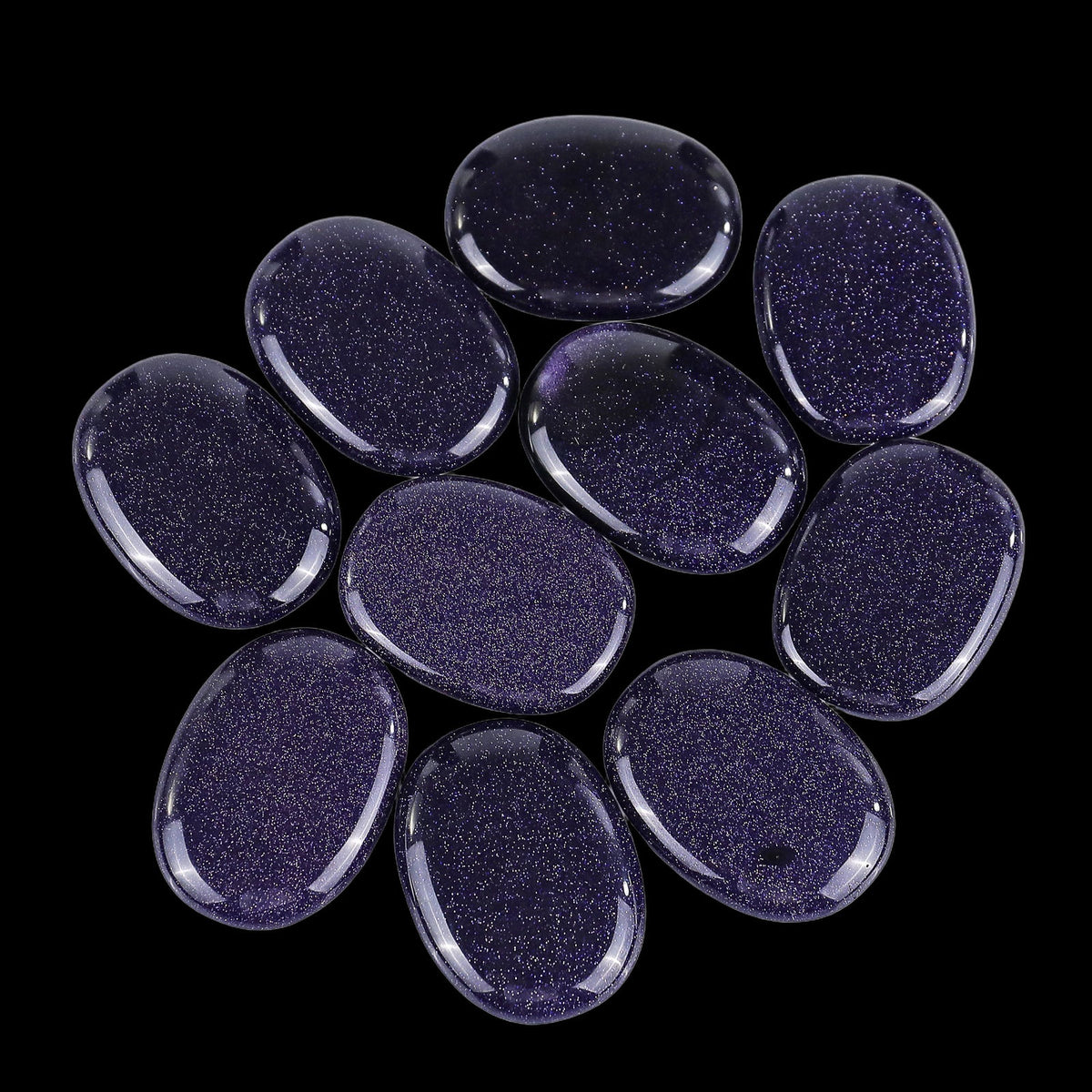
Goldstone is a man-made glass full of tiny, flat, highly reflective copper crystals. According to Geology.com, copper oxide is dissolved into the glass melt, which is then cooled slowly so metallic copper crystals can grow; the glass color of blue goldstone comes from cobalt. Before it was called goldstone, it was widely known as “aventurine glass,” which is why it is sometimes confused with aventurine, a natural quartzite with mica sparkle.
How to recognize it: a glassy body with an even field of pinpoint metallic flecks running through the whole piece, and much less variation from piece to piece than natural stone shows. If a lot of “sparkle stone” looks identical across every piece, ask whether it is goldstone.

Opalite
“Opalite” has two meanings. Geology.com explains that it was an older name for natural common opal (opal without play-of-color), and that since the 1980s it has also been used as a marketing name for man-made glass or plastic with an opal-like look, often sold without disclosure of its man-made origin. Geology.com adds that imitations are fine to sell as long as they are not passed off as natural opal, and that if “opal” appears in the product name, the man-made origin should be clearly disclosed.
In our catalog, “Opal” and “White Opal” appear as material names on three designs. The opal in our catalog is natural opal, not opalite glass, and it is not treated.
Terahertz
Terahertz is a trade name, not a mineral species name. Sellers give differing accounts of what it is made of, so we do not repeat any composition claims; we label it man-made. On our site it appears in two skull designs, the elf alien skull and the realistic human skull, listed as “Terahertz (manufactured).”
Colored “obsidian” glass
Natural obsidian is volcanic glass. The International Gem Society warns that manufactured blue, green or red glass is sometimes passed off as natural obsidian, and that transparent green, blue and reddish natural obsidian is very rare. A brightly colored, transparent “obsidian” is a reason to ask the supplier what it is.
Treated stones are a separate question
Treatment does not make a stone man-made, but it does change what you should tell your customers. GIA's gem treatment overview lists chalcedony, quartz, howlite and lapis lazuli among materials that have been dyed, notes that quartz is occasionally coated with metal oxides to create colors rarely seen in natural quartz, and names amazonite and serpentine among opaque gems commonly impregnated with wax or plastic. It also warns that many dyes can be removed by alcohol or acetone and some fade in sunlight. That is why a dyed piece needs its own care instructions.
Visual checks can raise a question but rarely settle it. Color pooled in cracks, a coating that looks unnaturally iridescent, or a whole lot with identical color are reasons to ask the supplier and, for valuable pieces, a gem lab.
How to label man-made and treated materials when you resell
In the United States, the Federal Trade Commission's Guides for the Jewelry, Precious Metals, and Pewter Industries (16 CFR Part 23) are the main reference for gemstone wording. They cover “gemstones and their laboratory-created and imitation substitutes” at every level of the trade. Three sections matter most here:
- § 23.25: words such as “stone” or “gemstone,” or a gem name, should not be used for a laboratory-created or imitation product unless they are immediately preceded, with equal conspicuousness, by a word like “laboratory-created,” “imitation” or “simulated.” The Guides add that “faux” alone is not an adequate disclosure.
- § 23.27: “real,” “genuine,” “natural” and similar words should not describe a product that is manufactured or produced artificially.
- § 23.24: a treatment should be disclosed if it is not permanent, creates special care requirements, or significantly affects value. For online sales, the disclosure belongs in the product description.
The Guides are written for jewelry industry products, so whether and how they apply to decorative carvings in your market is a question for your own adviser. As a working rule, they point to plain labels such as:
- “Blue goldstone (man-made glass) palm stone”
- “Opalite (man-made glass) tower”
- “Terahertz (man-made) skull carving”
- “Dyed howlite”, rather than “turquoise”
Keep the same wording on shelf tags, online listings and invoices, and avoid “natural” or “genuine” anywhere near a man-made material.
Our labeling: in our catalog, goldstone (including blue and red goldstone) and terahertz are labeled man-made on every listing. Our other materials are natural stone, meaning mined rather than man-made. The stones are not dyed and not heat-treated. The opal in our catalog is natural opal, not opalite glass, and it is not treated. We can confirm this in writing with your quotation, for use in your own product descriptions.
Why man-made materials still have a place in a shop
Goldstone and similar materials are consistent from piece to piece, which makes them easy to sell from a photo, and they give a look that natural stone does not. A shop that labels them clearly can stock them next to natural stone without confusing anyone. Our craftsmanship page explains why natural stones vary from piece to piece and man-made materials do not. You can see the goldstone palm stones alongside natural stones in our crystal shapes collection.