

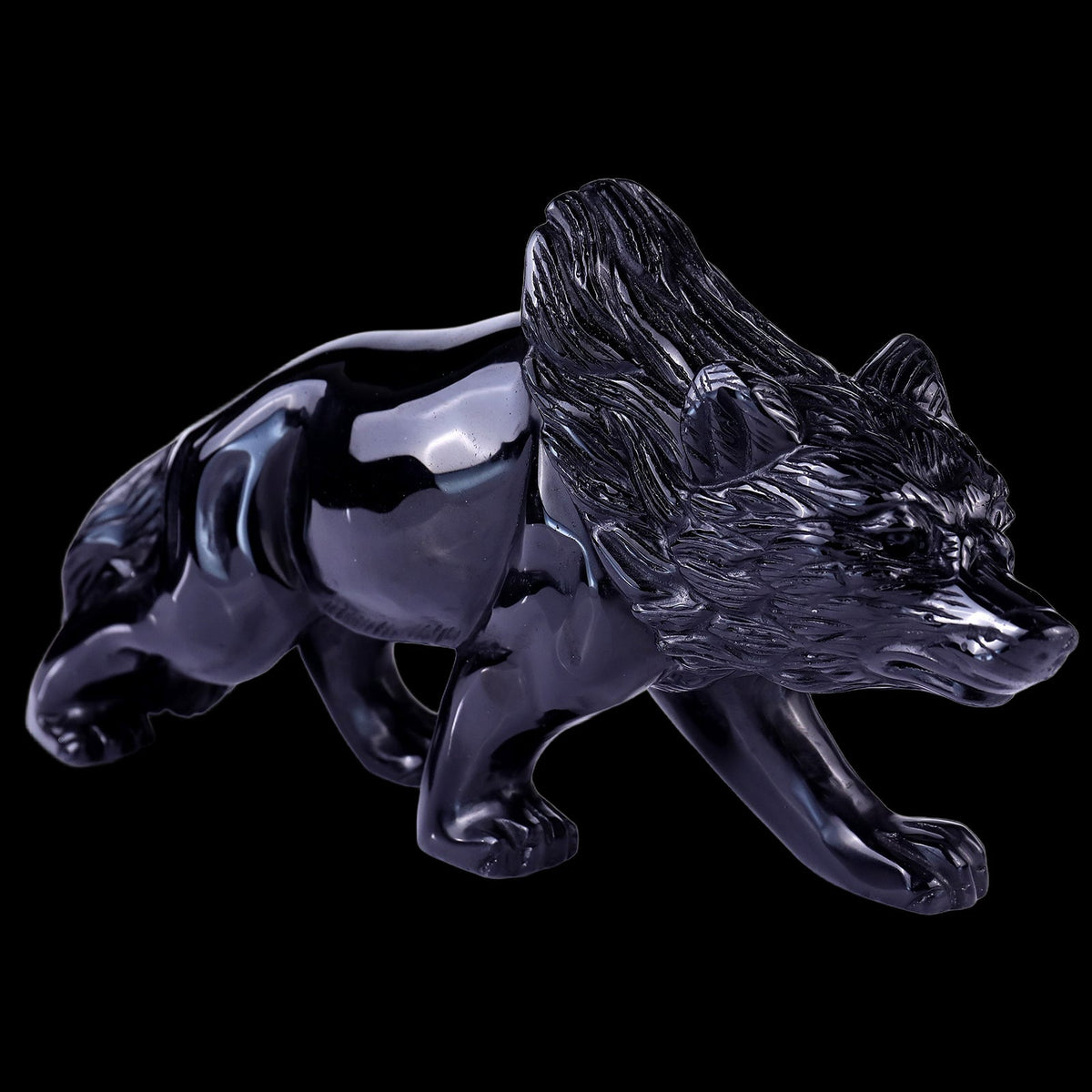
Black obsidian is natural volcanic glass, not a crystal. It carves easily and takes a bright, glassy polish, but it is softer than quartz and chips on impact, so it needs more careful packing and display than harder stones such as quartz. As of November 2026, 27 designs in our catalog are offered in black obsidian; you can compare them in the black obsidian carvings collection.
This guide covers what a buyer needs before ordering obsidian in quantity: how the material behaves, how black obsidian differs from snowflake obsidian, what reference sources say about telling obsidian from manufactured glass, and how our obsidian designs break down by size.
What black obsidian is
According to Geology.com, obsidian forms when molten rock cools so quickly that its atoms cannot arrange themselves into a crystal structure. The result is an amorphous material, classed as a mineraloid rather than a mineral. It can form along the edges of lava flows and volcanic domes, around sills and dikes, and where lava meets water. Black is the most common color.
Geology.com describes the result as a volcanic glass with a smooth, uniform texture, and IGS lists obsidian with no cleavage. In our catalog it is used for smooth, rounded forms such as skulls, sleeping cats and palm stones, where the polished surface carries the design.
Hardness, brittleness and what they mean for shipping
Obsidian is about 5–5.5 on the Mohs scale. The International Gem Society (IGS) lists 5 to 6, with the higher figure for basalt glass, and Geology.com gives about 5.5. That is softer than quartz and chalcedony, which sit around 7.
Toughness matters as much as hardness. Obsidian breaks with a conchoidal fracture, the curved, shell-like break that IGS calls the best example of this fracture type, and the broken edges are very sharp. Geology.com notes that it lacks toughness and is easily broken or chipped on impact. Obsidian chips easily, so if you stock worn pieces such as obsidian bead bracelets, remind customers to protect them from knocks. For carvings, the practical checks are these:
- Thin projections are the weak points. Ears, tails, horns, wings and the rims of eye sockets take the knocks. Ask how each piece is wrapped, and whether pieces with projections are boxed individually.
- Keep obsidian away from harder stones. Packed loose with quartz-family carvings, it can pick up scratches and edge chips. The same applies to display trays and bins.
- Check edges on arrival. Inspect the base and projections when you unpack, before pieces go out on the floor.
- Avoid heat and machine cleaning. IGS describes obsidian as heat-sensitive and advises against mechanical cleaning systems, because inclusions may expand when heated. Mild soap, a soft brush and warm water are enough.
Our guide to choosing stones for crystal carvings compares obsidian's durability with the other stones in our catalog.
Polish and shelf appearance
Obsidian has a vitreous (glassy) luster, according to IGS, and a well-polished black piece is highly reflective. A plain black surface has no pattern to hide fine scratches, which is why the packing and handling points above matter more for obsidian than for a patterned stone such as jasper.

Black obsidian vs. snowflake obsidian
Snowflake obsidian is the same volcanic glass with white or gray spots. Geology.com explains that, with the passage of time, some obsidian begins to crystallize at scattered points in the rock, forming radial clusters of white or gray cristobalite. IGS describes the same inclusions as snowflake-like spherulites of cristobalite.
| Black obsidian | Snowflake obsidian | |
|---|---|---|
| Material | Volcanic glass | Volcanic glass with cristobalite clusters |
| Look | Uniform glassy black | Black with white or gray "snowflakes"; pattern differs on every piece |
| What to approve | Polish and edges | Polish, edges and how much white shows on the face of the carving |
| In our catalog (November 2026) | 27 designs | 1 design: the leopard, at about 3 in |
IGS also lists rainbow and fire obsidian, which owe their colors to magnetite nanocrystals, and sheen obsidian, which owes its sheen to gas bubbles. We do not list those varieties.
Telling obsidian from manufactured black glass
Natural obsidian and manufactured glass are both glass, and IGS describes the features that help separate them: natural obsidian may contain crystallites that stand out in high relief under magnification, and straight banding and needle-like inclusions are signs of natural origin. IGS adds that a magnetic reaction can support an identification but is not a definitive test, and that a refractive index reading separates obsidian from lookalikes such as chalcedony and schorl.
For a wholesale order, the practical step is paperwork rather than testing: ask the supplier to name the material on the quotation and the invoice, and keep the same name on your labels. If a disagreement over identity ever matters, a gem lab can test a sample. Our black and snowflake obsidian is natural volcanic glass, not dyed and not heat-treated. IGS also warns that manufactured blue, green or red glass is sometimes passed off as rare-colored natural obsidian; for more on this, see man-made vs. natural stones in crystal carvings.
Black obsidian designs in our catalog
As of November 2026, the obsidian collection lists 27 designs: animals, dragon and fantasy pieces, skulls, Halloween designs, polished shapes and a bead bracelet. Measured on the longest side of each recorded sample, black obsidian pieces run from about 1.2 in (a heart) to about 15.4 in (the realistic human skull). Many designs come in more than one size, so the bands below overlap.
| Longest side | Designs with a black obsidian size in this band | Examples |
|---|---|---|
| Up to 3 in | 14 | Heart, worry stone, sleeping cat, panda, palm stone, punk skull |
| Over 3 in to 6 in | 9 | Elf alien skull, elephant, lizard, hippopotamus, wizard pumpkin |
| Over 6 in | 9 | Wolf, leopard, dolphin, rhinoceros, Persian cat, winged skull |
The bead bracelet has no recorded size and is quoted on request. Dimensions and weights refer to recorded samples; production dimensions, tolerances, finish, packaging and availability are confirmed with your quotation.
Minimums apply per catalog item (one design in one stone and one size). In our current wholesale catalog they are typically 10 pieces per design for carvings up to about 3–4 in, 5 pieces around 4.5–5 in, 2 pieces at 6–8 in, and single pieces for large carvings. Your quotation confirms the minimum for each item. For an obsidian design that is not in the catalog, see custom crystal carving.