Rose quartz is a translucent pink variety of quartz, rated 7 on the Mohs scale, and a popular material for small carved figures. For a wholesale buyer the questions that matter are how much the color varies from piece to piece, whether it fades on the shelf, what treatments exist, and which designs and sizes are available. This guide answers those questions; the designs themselves are in our rose quartz carvings collection.
What rose quartz is
Rose quartz is silicon dioxide (SiO2), the same mineral as clear quartz and amethyst. The rose quartz used for carving is the massive form: a solid mass of intergrown crystals, not single well-shaped crystals. Mindat describes this massive type as "the rose quartz that is used in lapidary and carvings." A rarer, separate form grows as small transparent pink crystals, often called pink quartz. The two behave differently in light, which matters for the fading question below.
Why it is pink, and why it is cloudy
According to GIA, the color comes from microscopic inclusions of aligned silicate mineral fibers, similar to but not identical with dumortierite. Mindat describes the same fibers as a pink borosilicate related to dumortierite. These fibers are also why rose quartz looks soft and hazy rather than glass-clear: GIA attributes its "cloudy translucence" to them.
Two practical consequences for an order:
- Color varies. GIA notes that the most appealing color typically occurs in larger sizes and that small rose quartz with good color tends to be scarce, so small carvings may run paler than large ones. Expect shade differences within one batch as well.
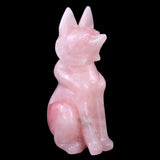
- Inclusions show. GIA describes the color as ranging from very light pink, almost white, to medium-dark pink, and notes that rose quartz often has internal fractures that add to its cloudy look. Lighter zones and small inclusions, like the gray spot on the fox below, are part of the material. If your shop needs closely matched color, say so when you order and ask for photos of the finished batch.

Does rose quartz fade in sunlight?
This is the question buyers ask most, and the short answer depends on which form of pink quartz is meant.
| Form | Color cause | Light stability |
|---|---|---|
| Massive rose quartz (used for carvings) | Pink mineral fibers | Mindat: color generally stable in ultraviolet light, although there have been occasional reports of material that pales quickly in daylight. IGS: the more common rose quartz does not have the UV sensitivity of pink quartz |
| Transparent pink quartz crystals (rare) | Color centers involving aluminum and phosphorus | IGS: significant sensitivity to UV, can lose color rapidly under exposure; GIA notes that material from some deposits fades when exposed to natural light |
So rose quartz carvings are not expected to fade as a rule, but the occasional exception is on record. Keeping display pieces out of hours of direct sun in a shop window is a low-cost precaution, not a requirement the sources set for carving material.
Treatments and synthetics
The two gem references word this differently. GIA's rose quartz buyer's guide says rose quartz is occasionally irradiated to intensify its color. IGS says rose quartz typically receives no treatments or enhancements (its property table gives "usually none" under enhancements, while also listing irradiation under typical treatments), notes that some pink quartz crystals may turn strawberry red when irradiated, and adds that irradiation can restore color in the light-sensitive pink quartz. Both GIA and IGS describe synthetic pink quartz grown with aluminum or phosphorus and then irradiated; Mindat notes that the synthetic counterpart is of the crystal type, not the massive type used for carving. None of these sources describes a visual test for irradiation. If treatment disclosure matters for your labeling, ask the supplier in writing what it can state about the material, and treat any answer as the supplier's statement rather than a lab result. These sources describe rose quartz on the market in general. Our rose quartz is natural rose quartz, not dyed and not heat-treated, and we can confirm this in writing with your quotation. Our guide to man-made and natural stones covers disclosure questions across materials.
How it carves and polishes
At Mohs 7, rose quartz resists scratching on a shelf, and IGS lists it with no cleavage, so it does not tend to split along flat planes. Mindat's quartz entry describes quartz as brittle with a conchoidal (shell-like) fracture, though tough when massive. Thin points such as ears, wing tips and tails are the parts most exposed to chipping. It takes a glassy (vitreous) polish. Because the stone is translucent, light passes into the surface and carved detail reads softer than it does in an opaque stone. GIA notes that rose quartz has been popular with gem carvers for figurines and other small decorative objects, which matches the rounded animal and fantasy shapes in our catalog.

Display and care for retail
- Cleaning: GIA recommends warm, soapy water and advises against ultrasonic and steam cleaners; IGS suggests warm water, detergent and a soft brush rather than mechanical cleaning systems.
- Handling: Shelve pieces with thin projections toward the back or in a case, and pack them separately when you rotate stock.
- Lighting: Light from behind or above shows the translucence. Pair rose quartz with an opaque stone in the same design if you want customers to compare color and finish side by side.
- Labeling: "Rose quartz" is the standard name. IGS warns that it is sometimes sold under the misleading names "American ruby" or "Bohemian ruby"; keep those off your tags.
Rose quartz in our catalog
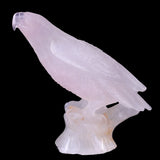
As of November 2026, 31 designs in our catalog are offered in natural rose quartz. Across 44 recorded rose quartz sizes (30 designs; the bead bracelet is size on request), the longest side runs from about 1.6 in for the smallest pieces, such as the worry stones, to 11 in for the lidded bowl. Eighteen designs have a rose quartz size of 3 in or under on the longest side, and three (the parrot, the realistic human skull and the lidded bowl) have one of 6 in or more.
| Line | Designs | Examples |
|---|---|---|
| Animal carvings | 10 | Sleeping cat, fox, elephant, polar bear, parrot |
| Dragons and fantasy | 5 | Baby dragon, dragon skull, unicorn, flower fairy |
| Seasonal | 5 | Ghost, wizard ghost, pumpkin, bearded elf |
| Skulls | 3 | Realistic human skull, phoenix skull, raven skull |
| Crystals and stones | 3 | Pyramid, worry stone, heart worry stone |
| Home and display | 2 | Incense holder, lidded bowl |
| Massage tools | 2 | Massage tool, massage wand |
| Jewelry | 1 | Bead bracelet |
Minimums apply per catalog item (one design in one stone and one size). In our current wholesale catalog they are typically 10 pieces per design for carvings up to about 3–4 in, 5 pieces around 4.5–5 in and 2 pieces at 6–8 in; your quotation confirms the minimum for each item. Dimensions and weights refer to recorded samples; production dimensions, tolerances, finish, packaging and availability are confirmed with your quotation. To plan sizes across a shelf, see the crystal carving size guide; for a rose quartz design that is not listed, see custom crystal carving.